Introduction
When you apply for credit, lenders carefully examine your financial profile to see if you are a safe bet to borrow money. Common Loan Application Mistakes That Cause Rejection means the specific application errors, financial missteps or omissions made by applicants during underwriting that end up getting the lender to reject your request for funds. Borrowers usually type in this search word either to try and avoid a denial before submitting an application or to figure out why their most recent loan attempt was denied. Well provided your details are rightly submitted, debt to income ratio, credit history behavior as well as job stability will determine whether or not your application gets approved.

A sane approximation of the financial mechanics behind these blunders is necessary for almost any salaried professional, self-founded condomers indebt to investors if we ever wish to have a positive lending experience as a first-time borrower. This is a disclaimer that loanrejectionhelp.
Disclaimer: Non-public info will not be offered by com is for informational purposes solely and doesn’t represent monetary recommendation. Individual lender policies apply to all approvals for loans. Taking on debt is a financial risk and requires you to consider whether or not the money you owe can be repaid before agreeing to any line of credit.
Table of Contents
What Are Common Loan Application Mistakes That Cause Rejection?
Common loan application mistakes that will get you rejected For example, rather than filling out just a loan application form: it is, in reality, you financially credibly snapshot. It is used as an assessment tool by lenders who are weighing the risk.
If the snapshot indicates any inconsistencies or potential for financial difficulty, then their automated systems or manual underwriters will automatically flag the application. Below is an analysis of the common financial mistakes that lead to a declined application.
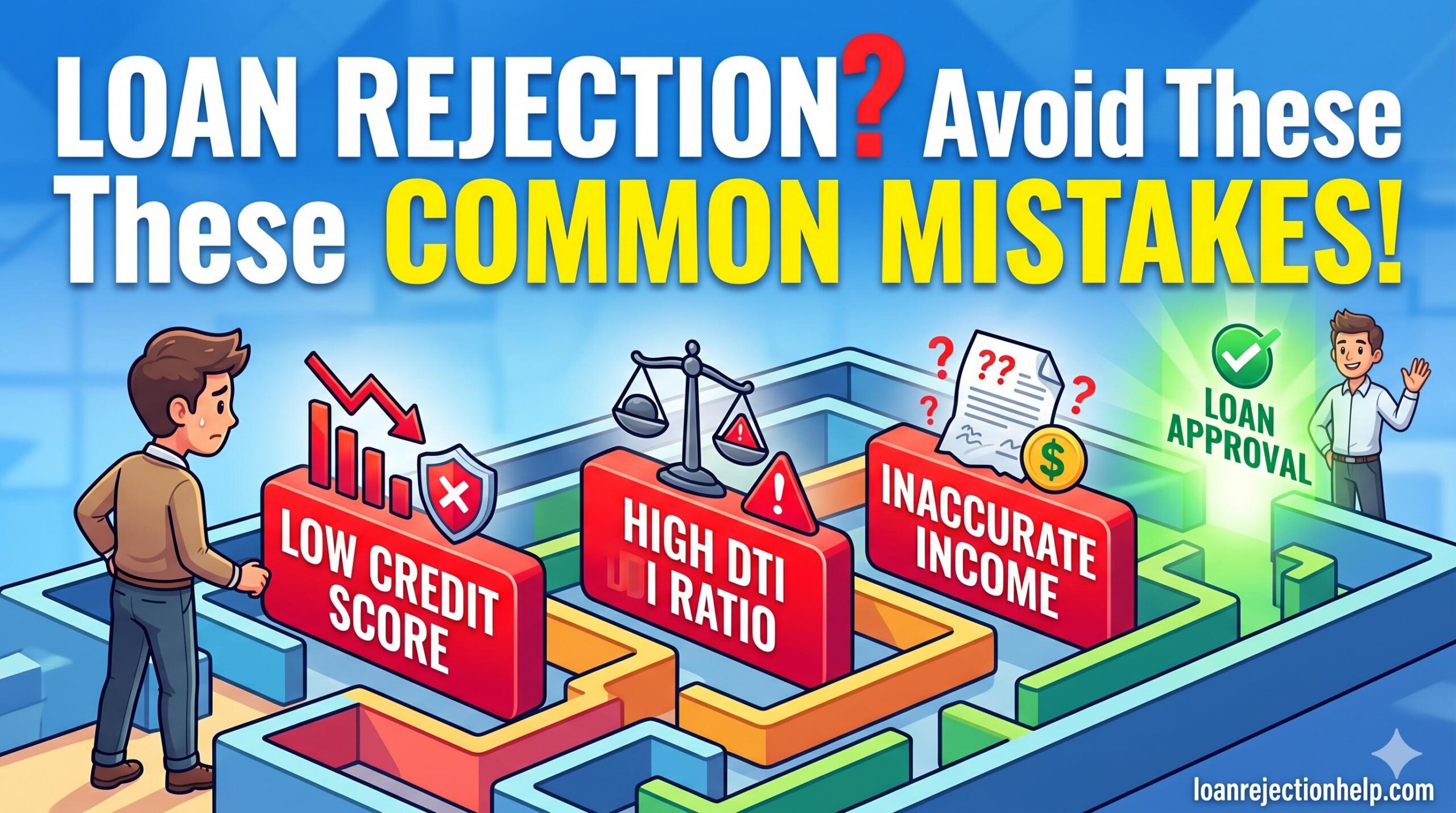
1. High Debt-to-Income (DTI) Ratio

Debt march ratioOne of the most important fiscal concepts lender evaluate is your Debt-to-Income (DTI) ratio. This is what portion of your gross monthly income you use for existing monthly debt payments.One of the most critical financial concepts lenders evaluate is your Debt-to-Income (DTI) ratio. This is the percentage of your gross monthly income that goes toward paying your existing monthly debts.
The Mistake: Getting a new loan when your DTI is already too high.
The Financial Reality: A DTI of above 36% to 43% (depending on the lender) means you are over-leveraged…even with great credit. Lenders shy away from high DTI applications because a monthly payment increases the statistical chance of default. First, you must calculate your DTI before applying to make sure that you still have some disposable income left for a new loan.
2. Inaccurate or Incomplete Application Details
Data verification is critical for underwriting. Every single number, every address has to match with your Bank Account Number that you provided earlier and it should be identical with the records held by Credit Bureaus also.

The Mistake: Estimating your income, using rounded numbers, or entering typographical errors on the application instead of paying attention to what you write.
The Financial Reality: Borrowers confuse their gross income (amount before taxes) with their net worth (take-home pay). Basically, if you disclose an income that is higher than what your tax returns or bank statements show the lender will consider this gap a red flag. Even seemingly benign errors — like the candidate’s social security number came out wrong or their previous address is misspelled, among others can trigger identity verification software to reject an application automatically as a measure against fraud.
3. Applying for Too Much Credit at Once
Whenever you apply for a loan or credit card, the lender does what is called “hard inquiry” on your credit report.
The Mistake:“Doing rate shopping” wrong by submitting multiple applications across different lenders over time.
The Financial Reality: Hard inquiries only hurt your credit score temporarily. But I think the most important thing is that they will see multiple recent hard inquiries and know that you are either desperate for credit or living on borrowed money. We are in a space full of warning signs when it comes to finance. To compare rates, use platforms that do “soft inquiries” (which don’t impact your score) or stick with the same kind of lender over a short two-week period to consolidate your rate shopping.
4. Unstable Employment or Income History
Lenders want assurances you will have a stable income to repay them out your loan over its term.
The Mistake: Immediately applying for a loan after swapping lines of work, kicking off another business or suffering an employment gap.
The Financial Reality: Most lenders want you to have two consecutive years of solid employment in the same field. A fluctuating income, when Earning Records like two years worth of tax returns are not available to help funders get an average monthly (gross) amount you earn- their article recommends self-employed pros be turned down flat in your application.
Steps to Take Before Applying for a Loan

At loanrejectionhelp. At moneywellspoken. In order to stay clear of some of the common loan application mistakes that end up getting rejected, follow these prudent steps:
- Review Your Credit Report: Before a lender checks your credit report, you can get a free copy and review it for errors. Dispute any inaccuracies.
- Calculate Your Needs: Only borrow the amount you really need. Asking for too much money will raise the percentage of your debt to income and increase your chances of denial.
- Gather Documentation: Prepare recent pay stubs, W2s/tax returns, and bank statements so that you can simply input accurate figures into your application.
Personal Loan vs Credit Card Loan: Which is Better for Your Financial Health?
Frequently Asked Questions (FAQ)
What is the most common reason for a loan rejection?
The reasons for not getting a loan differs from person to person, but the two most common reasons are a high Debt-to-Income (DTI) ratio and a low credit score. Lenders love to see that you have a track record of timely payments on any existing debts you might have, with sufficient disposable income left over each month to absorb new debt.
Will a rejected loan application hurt my credit score?
This initial rejection will not show on your credit report therefore is not counted against you in respect to getting and using a loan. But once you put in your application, it generates a hard inquiry, and that results in a minimal drop in your credit score (that will be temporary).
How soon can I reapply after my loan is rejected?
There is no legally required waiting period, but we highly suggest that you not get remarried for at least 3–6 months. You can use this time frame you have to do things that may address your reason for the denial such as paying down existing debt, rectifying data errors on your credit report etc.
Risk Awareness Statement: Debt is a serious financial commitment for which you may be held liable. This will damage your credit score and make borrowing in the future more expensive and harder. Never sign a contract without setting up a monthly budget to determine if your funds will be enough to cover payments.