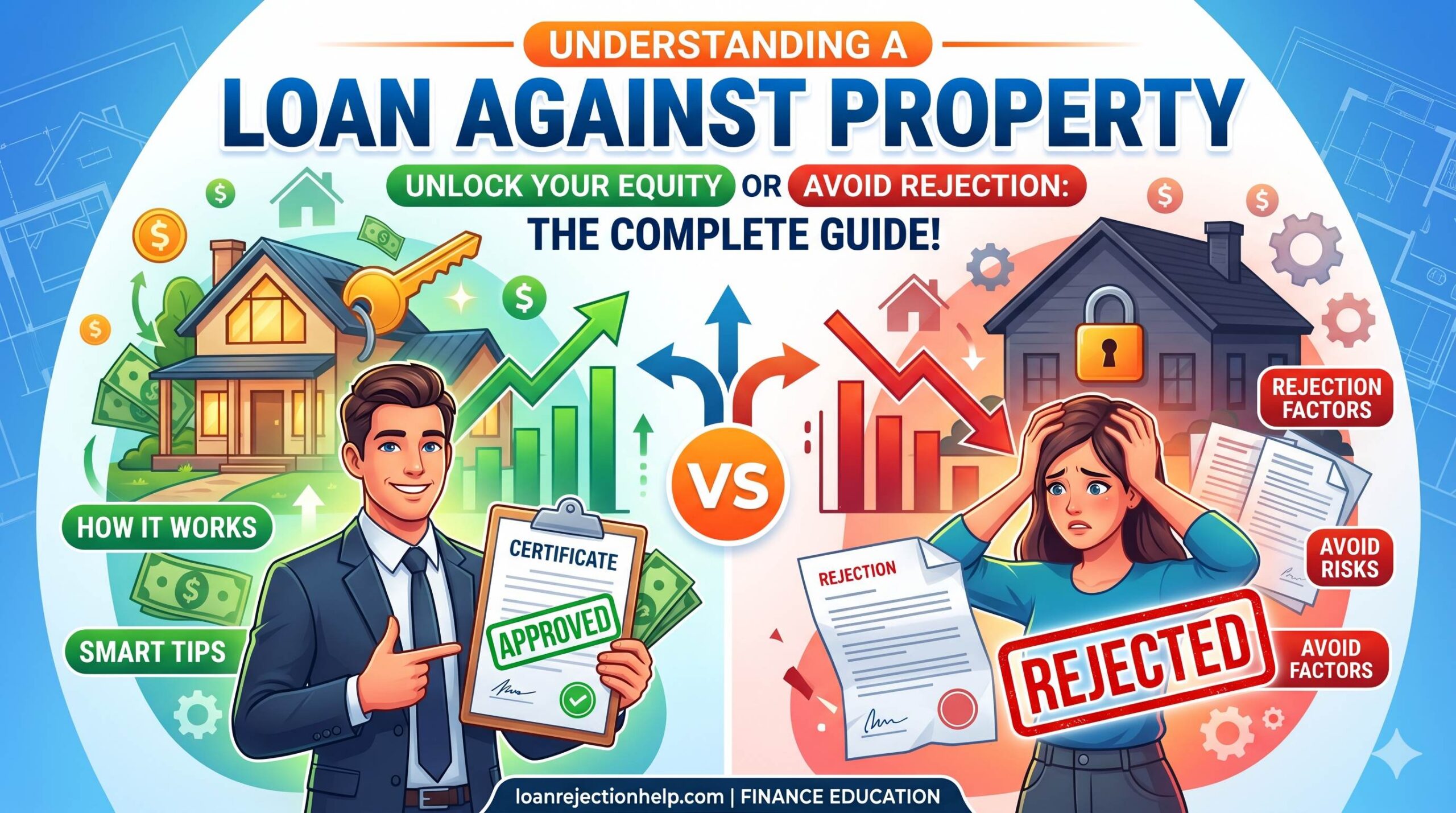
Introduction: What is a Loan Against Property?
A loan against property (often abbreviated as LAP) is a type of secured loan where you pledge your residential, commercial, or sometimes industrial real estate as collateral to borrow a substantial amount of money from a bank or financial institution. Borrowers frequently search for this specific financial product because it allows them to unlock the illiquid, “dead” value tied up in their real estate, providing access to large funds at significantly lower interest rates compared to unsecured credit like personal loans or credit cards.

However, the exact loan amount you are eligible for, the interest rate you are offered, and your ultimate approval depend heavily on three major factors: the current market value of your property, your personal or business credit score, and your verifiable income history.
At LoanRejectionHelp.com, our goal is to empower you with financial literacy. Before we dive into why lenders might decline your application and how to improve your creditworthiness, it is crucial to fully understand the mechanics, interest rates, and inherent risks of taking out a collateral-backed loan.
Table of Contents
How Does a Loan Against Property Work?
When you apply for a loan against property, you are essentially telling the lender, “I need to borrow money, and if I fail to repay it, you have the legal right to seize and sell my property to recover your funds.” Because the lender has this safety net (the collateral), their risk is vastly reduced. This reduced risk translates into financial benefits for the borrower.
The Role of Loan-to-Value (LTV) Ratio
Lenders will not give you a loan equal to 100% of your property’s worth. Instead, they use a metric called the Loan-to-Value (LTV) ratio. The LTV ratio is the percentage of the property’s current market value that the bank is willing to lend.
For a loan against property, the LTV typically ranges from 50% to 70%. For example, if you own a commercial shop valued at $100,000, and the lender offers a 60% LTV, the maximum loan amount you can receive is $60,000. The remaining 40% acts as a buffer for the lender to account for market fluctuations and the costs associated with selling the property if you default.
Understanding the Interest Rates
The primary reason a loan against property is so attractive is the interest rate structure. Because the loan is fully secured, financial institutions offer highly competitive rates. Borrowers usually have two choices:
- Fixed Interest Rates: The rate remains the exact same throughout the entire tenure of the loan. This offers predictable monthly Equated Monthly Installments (EMIs) but generally starts at a slightly higher percentage than variable rates.
- Floating (Variable) Interest Rates: The interest rate is tied to a broader economic benchmark. If the central bank raises interest rates, your loan rate will increase, and your EMI or loan tenure will adjust accordingly. Conversely, if rates drop, you save money.
Why Do Borrowers Choose This Financial Route?
Understanding the core advantages of a loan against property highlights why it is a fundamental tool for wealth management, business growth, and handling life’s major expenses.
- Access to High Loan Amounts: Because real estate is typically high-value, borrowers can secure much larger sums than they could through an unsecured personal loan.
- Extended Repayment Tenures: Lenders often allow you to repay a loan against property over 10 to 15 years (and sometimes up to 20 years). A longer tenure spreads out the principal and interest, making the monthly EMI much more manageable for salaried individuals and self-employed professionals alike.
- No Usage Restrictions: Unlike a car loan or a home purchase loan, the funds from a LAP can be used for almost any legitimate purpose. Borrowers commonly use the money for business expansion, funding a child’s higher education abroad, managing sudden medical emergencies, or consolidating high-interest debts into one lower-interest payment.
- Continued Property Usage: Pledging your property does not mean you have to vacate it. You retain full ownership, occupancy, and usage rights of the residential or commercial space as long as you make your standard EMI payments on time.
The Risks: Responsible Borrowing Awareness

While a loan against property is a powerful financial tool, it carries severe consequences if mismanaged. We strongly advocate for responsible borrowing. The most critical risk is foreclosure. If you face an unexpected job loss, business failure, or financial crisis and consistently miss your EMI payments, the lender will initiate legal proceedings to auction your property.
Furthermore, late payments will drastically reduce your credit score, making it incredibly difficult to secure any form of financing—even basic credit cards—in the future. You should never borrow against your home to fund high-risk investments, speculative stock trading, or unnecessary luxury expenses. Always calculate your monthly budget to ensure the EMI fits comfortably within your verifiable income.
Why Does a Loan Against Property Get Rejected?
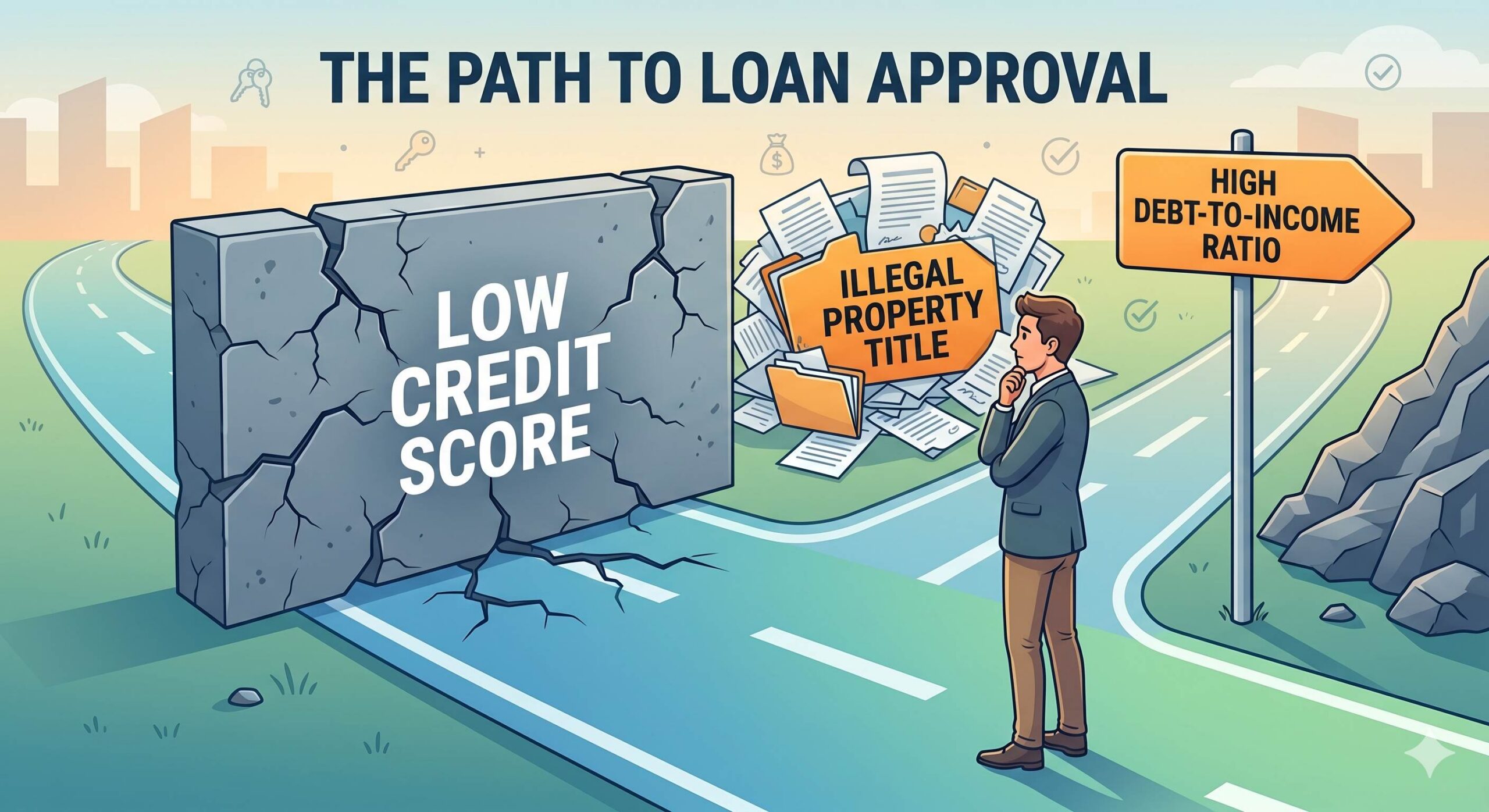
Even though the loan is secured by valuable real estate, lenders evaluate applications strictly. If you have faced a loan rejection, it is likely due to one of the following roadblocks:
1. Legal and Technical Property Issues
Lenders conduct rigorous physical and legal checks on the collateral. If the property’s title is disputed, if there are multiple unregistered owners, or if the building was constructed without proper municipal approvals, the application will be rejected immediately. Lenders need a clear, unencumbered title so they can legally sell the property if a default occurs.
2. Poor Credit Score and Repayment History
Your credit score is a numerical representation of your financial discipline. Even with a multi-million-dollar property, a low credit score signals to the lender that you are a high-risk borrower who struggles to manage debt. Past defaults, late credit card payments, or previously written-off loans will lead to a swift rejection.
3. High Debt-to-Income (DTI) Ratio
Lenders look closely at your Debt-to-Income ratio, which measures how much of your gross monthly income goes toward paying existing debts. If you earn $5,000 a month but already pay $3,000 toward other personal loans and auto loans, your DTI is 60%. Most lenders prefer a DTI ratio below 40% or 50%. If a new loan against property EMI pushes your debt burden too high, the bank will conclude that you lack the financial capacity to take on more debt.
4. Property Location and Condition
Lenders are highly specific about the geographical locations they serve. Properties located in highly remote areas, outside city limits, or in zones prone to natural disasters may be rejected. Furthermore, old, dilapidated buildings with weak structural integrity are viewed as poor collateral because they are difficult for the bank to sell in the open market.
Actionable Steps to Improve Your Approval Chances
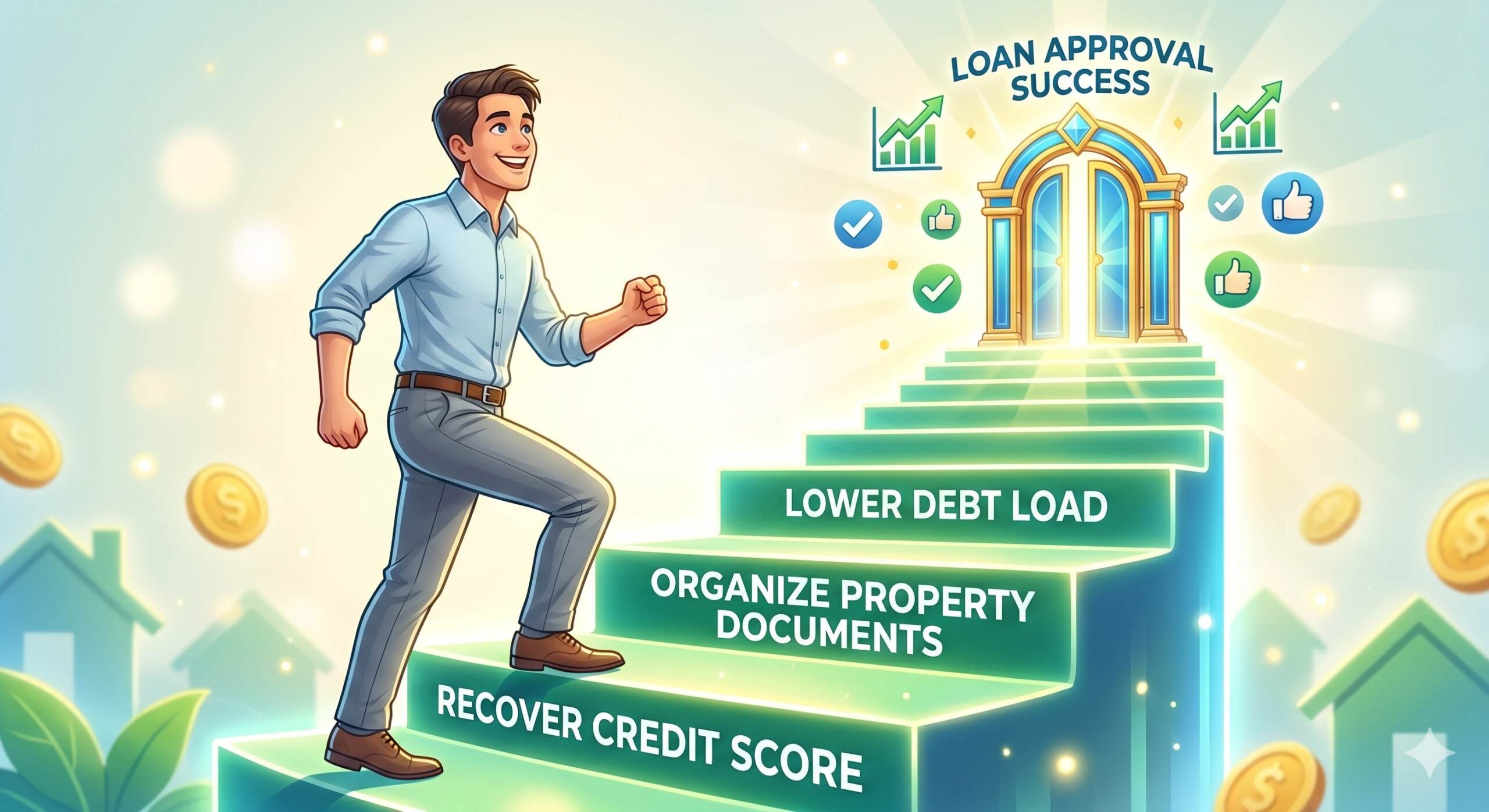
If you are a first-time borrower or someone looking to overcome a past rejection, taking proactive steps can significantly boost your profile:
Apply with a Co-Applicant: If your income is deemed insufficient, adding an earning family member (like a spouse or a parent) as a financial co-applicant can combine your incomes. This lowers the DTI ratio and increases the overall loan eligibility.
Review Your Credit Report: Obtain a copy of your credit report months before applying. Look for any clerical errors or outstanding micro-debts and resolve them. Consistently paying your current bills on time will slowly but surely improve your credit score.
Organize Your Property Documents: Ensure you have the original title deeds, updated tax receipts, and approved building plans ready. Consulting a property lawyer to verify your paperwork before approaching a bank can save you from technical rejections.
Lower Existing Liabilities: To improve your Debt-to-Income ratio, try to aggressively pay down smaller existing debts like credit card balances or short-term personal loans before applying for a massive secured loan.
Understanding the HDFC Gold Loan Interest Rate: Factors, Approval Tips, and Risks
Frequently Asked Questions (FAQs)
1. What is the difference between a home loan and a loan against property?
A home loan is specifically taken to purchase or construct a new property, and the lender pays the builder or seller directly. A loan against property is taken by pledging a property you already own, and the funds can be used for any legitimate personal or business reason, such as funding education or expanding a business.
2. Why was my loan against property rejected even though my property is highly valuable?
Lenders do not rely solely on property value. If your application was rejected, it is most likely due to a low personal credit score, an unverified income history, existing heavy debts (a high Debt-to-Income ratio), or legal issues with the property’s title documents. The bank needs assurance that you can make monthly payments, regardless of the collateral’s worth.
3. Can I get a loan against an agricultural property?
Most standard banks and financial institutions do not offer standard loans against agricultural land due to specific legal restrictions and the difficulty of selling the land in case of a default. However, some specialized rural banks or cooperative societies may have specific agricultural loan schemes.
4. Will applying for a property loan lower my credit score?
When you apply for any loan, the lender performs a “hard inquiry” on your credit report, which can cause a very small, temporary drop in your credit score (usually a few points). However, the real impact on your score comes from your repayment behavior. Consistently paying your EMIs on time will build an excellent credit score, while missed payments will severely damage it.
5. How much money can I borrow against my property?
Lenders use a Loan-to-Value (LTV) ratio, meaning they will not lend you 100% of the property’s market value. Generally, you can expect an LTV of 50% to 70%. For example, if your property is valued at $200,000, the maximum loan amount you might be eligible for is between $100,000 and $140,000, depending on your income and credit profile.
Conclusion: Smart Borrowing and Avoiding Rejection
A loan against property is one of the most effective ways to secure large-scale funding at competitive interest rates, making it an excellent tool for business expansion, medical emergencies, or debt consolidation. However, because your property is on the line, it requires a high level of financial maturity and responsible borrowing.
Lenders will not approve an application if the property has legal disputes, if the borrower has a poor credit history, or if the Debt-to-Income ratio is too high. To avoid the frustration of a loan rejection, take proactive steps: review your credit score months in advance, ensure all property titles and tax receipts are legally clear, and carefully calculate your EMI to ensure it fits comfortably within your budget. By prioritizing financial literacy and preparing your profile beforehand, you can successfully navigate the application process and make your real estate work for your financial goals.