Introduction
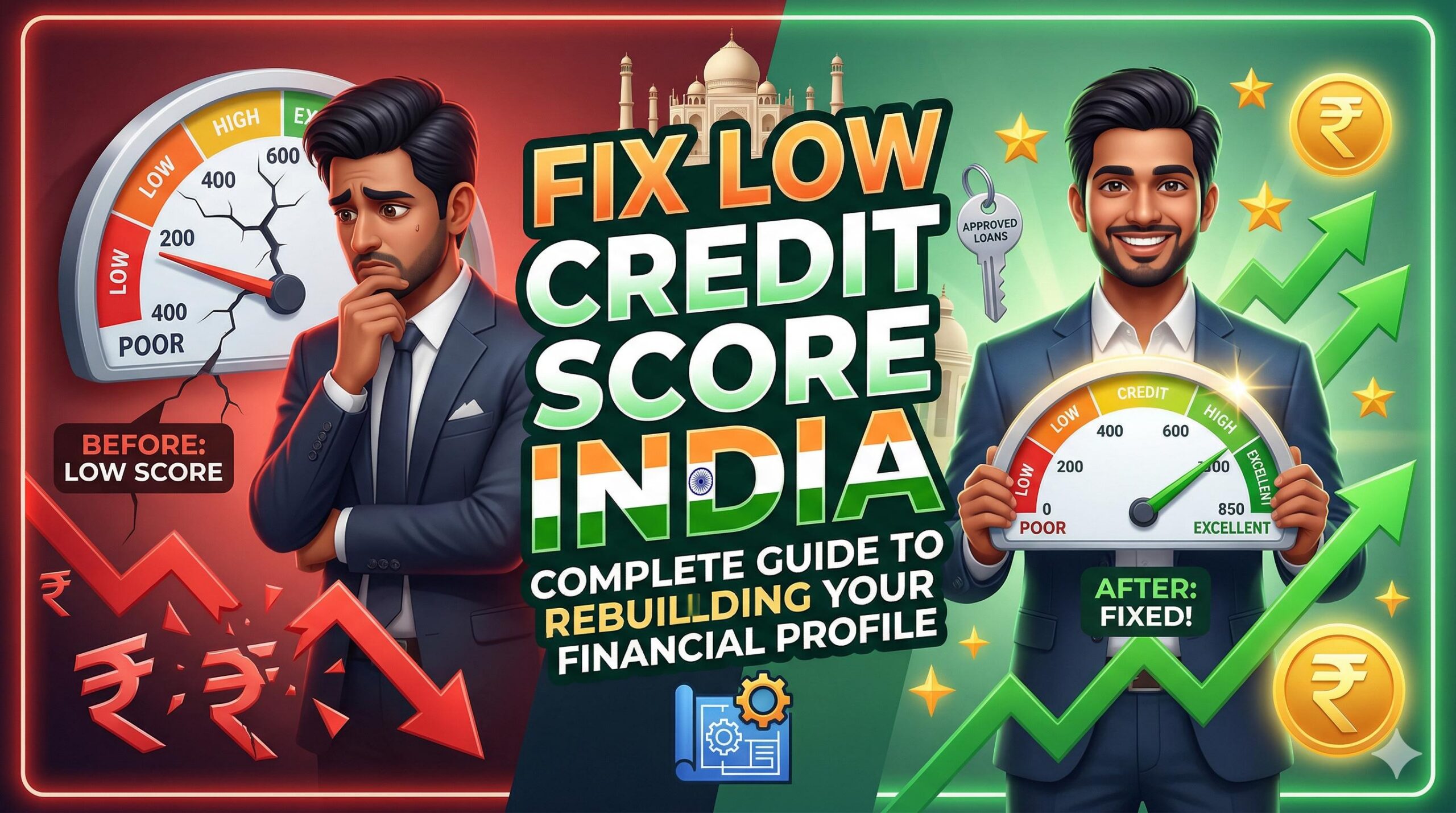
If you have recently faced a loan rejection or a credit card denial, you are likely searching for how to fix low credit score India. In the financial world, fixing a low credit score means taking strategic, consistent steps to improve your creditworthiness in the eyes of credit bureaus like CIBIL, Experian, Equifax, and CRIF High Mark. Borrowers search for this topic because a low score directly blocks them from accessing essential financial tools, leading to application rejections, higher interest rates, and unfavorable loan terms. Your credit score is primarily affected by your past repayment history, the amount of debt you currently hold, how often you apply for new credit, and the overall age of your credit accounts.
Understanding how your credit score works—and more importantly, how to repair it—is the foundation of strong financial health. In this comprehensive guide, we will explore exactly what pulls your score down, the step-by-step process to bring it back up, and how this directly impacts your ability to get a loan approved in the future.
Disclaimer: The information provided on loanrejectionhelp.com is for educational and informational purposes only. It does not constitute certified financial advice. We do not guarantee loan approvals or instant credit score improvements. Borrowing carries inherent financial risks; always practice responsible borrowing and only take on debt you can comfortably repay.
Table of Contents
Understanding the Credit Score System in India

Before you can fix a problem, you must understand how it works. In India, credit scores range from 300 to 900. This three-digit number acts as a financial report card for salaried individuals, self-employed professionals, and even first-time borrowers.
- 300 – 549 (Poor): High risk of loan rejection. Lenders view borrowers in this range as likely to default.
- 550 – 649 (Average): Loans may be approved, but usually with very high interest rates and strict conditions.
- 650 – 749 (Good): A decent score where most standard loans and credit cards are approved.
- 750 – 900 (Excellent): The ideal range. Borrowers here get quick approvals, the lowest interest rates, and premium credit card offers.
When your score falls below 700, lenders start to worry. If it drops below 600, rejections become the norm.
Why Did Your Credit Score Drop?
To effectively execute a strategy on how to fix low credit score India, you must first diagnose the root cause of the drop. Credit bureaus lower your score based on specific negative behaviors:

- Missed or Late Payments: This is the heaviest factor. Even one payment that is 30 days late can significantly damage your score.
- High Credit Utilization: Maxing out your credit cards signals to lenders that you are “credit hungry” and relying too heavily on borrowed money to survive.
- Multiple Hard Inquiries: Every time you apply for a loan or credit card, the lender checks your report (a “hard inquiry”). Applying for several loans back-to-back makes you look desperate and lowers your score.
- Closing Old Accounts: The length of your credit history matters. Closing your oldest credit card wipes out years of good repayment history.
- Errors on Your Credit Report: Sometimes, the low score isn’t your fault. Clerical errors, identity theft, or an administrative mistake by a bank can artificially drag your score down.
Step-by-Step Guide: How to Fix Low Credit Score India
Improving your credit profile is not an overnight process, but with financial discipline, it is entirely possible. Here is the educational roadmap to rebuilding your score.
1. Check Your Credit Report for Errors

The Reserve Bank of India (RBI) mandates that every individual is entitled to one free full credit report per year from each of the major credit bureaus.
- Action Step: Download your report and read it carefully. Look for loans you never took, payments marked as “late” when you paid on time, or incorrect personal details.
- The Fix: If you spot an error, file a dispute directly on the credit bureau’s website. Once the bank verifies the error, it will be removed, resulting in an immediate score boost.
2. Automate Your Repayments
Your repayment history makes up roughly 35% to 40% of your total credit score calculation.
- Action Step: Set up auto-debit mandates (NACH/ECS) for all your EMIs (Equated Monthly Installments) and credit card bills. Ensure your primary bank account has sufficient funds a few days before the due date. Consistency over six to twelve months will steadily pull your score upward.
3. Lower Your Credit Utilization Ratio (CUR)
Your CUR is the percentage of your total available credit limit that you are currently using. Financial experts recommend keeping this ratio below 30%.
- Example: If you have a credit card with a ₹1,00,000 limit, try not to carry a balance higher than ₹30,000 at any given time.
- The Fix: Pay down your existing credit card debt. If you cannot pay it all at once, pay more than the minimum due every month. Alternatively, you can ask your bank for a credit limit increase—but do not use the extra limit. This automatically lowers your CUR.
4. Stop Applying for New Loans Immediately
If you are facing loan rejections, the worst thing you can do is apply at another bank immediately.
- Action Step: Put a freeze on all new credit applications for at least 3 to 6 months. Give your credit profile time to breathe and age without new hard inquiries dragging it down.
5. Keep Old Credit Accounts Open
A long, stable credit history proves to lenders that you are experienced at managing debt.
- Action Step: Keep your oldest credit card active, even if you rarely use it. Make a small purchase on it once every few months and pay it off immediately to keep the account from being marked dormant.
6. Consider a Secured Credit Card (For Complete Credit Rebuilding)
If your score is too low to get a standard loan or credit card, a secured credit card is an excellent educational tool for rebuilding.
- How it works: You open a Fixed Deposit (FD) with a bank, and they issue a credit card backed by that FD (usually up to 80% or 90% of the FD value). Because it is secured by your own money, banks do not require a high credit score to approve it. By using this card responsibly and paying the bill on time, you generate positive data for the credit bureaus, gradually fixing your score.
How a Low Credit Score Leads to Loan Rejections
At loanrejectionhelp.com, we see many applicants confused as to why a bank turned them away despite having a good salary. Lenders use your credit score as a risk assessment tool.
When a bank processes your loan application, they are asking one question: “What is the statistical probability that this person will not pay us back?” * The Trust Deficit: A low score indicates a history of financial unreliability. Even if your current income is high, a bad track record makes banks view you as a high-risk investment.
- Strict Underwriting Policies: Many top-tier banks in India have automated systems that instantly reject applications if the CIBIL score is below a certain threshold (usually 700 or 750), regardless of your salary slips.
- The Cost of Risk: If a lender does approve a loan for a low-score borrower, they will charge a “risk premium”—meaning your interest rate will be significantly higher than the advertised market rate.
By following the steps on how to fix low credit score India, you are systematically removing these red flags, moving from a “high-risk” applicant to a “prime” borrower.
Understanding Loans for Blacklisted Borrowers: A Comprehensive Financial Guide
Realistic Expectations and Responsible Borrowing
As you embark on improving your financial literacy, it is vital to be aware of scams. There is no legal way to instantly erase accurate, negative information from your credit report. Avoid any company or agency that promises guaranteed overnight score improvements in exchange for a fee.
Rebuilding a credit score is a marathon, not a sprint. Depending on how severe the damage is—whether it is a few late payments or a complete loan default—it can take anywhere from 6 to 24 months of disciplined financial behavior to see a substantial recovery.
Always practice responsible borrowing. Never take out a loan just for the sake of trying to build credit if you do not have a clear, realistic plan to pay it back. Credit should be a tool that serves your financial goals, not a trap that leads to unmanageable debt.
By understanding the mechanics of your score, tracking your report, and maintaining strict payment discipline, you can successfully recover from past rejections and secure a stable financial future.
Frequently Asked Questions (FAQs)
1. How much time does it take to fix a low credit score in India? There is no overnight fix. Depending on the severity of the damage—such as a few late payments versus a major loan default—it generally takes between 6 to 24 months of consistent, on-time payments to see a significant improvement in your credit score.
2. Can I pay an agency to clear my CIBIL score instantly? No. It is crucial to be aware of credit repair scams. No agency or third-party company can legally remove accurate, negative information from your credit report, nor can they guarantee an instant score boost. The only way to improve your score is through time and responsible financial behavior.
3. Does checking my own credit score lower it? No, checking your own credit score is considered a “soft inquiry” and does not impact your score at all. You can—and should—check your report regularly to monitor your progress and spot any errors. Your score only drops during a “hard inquiry,” which happens when a lender checks your profile after you apply for a new loan or credit card.
4. Will closing my old credit cards improve my score? Closing an old credit card can actually hurt your score. It reduces your total available credit limit (which increases your credit utilization ratio) and wipes out your long history of good payments. It is usually better to keep old, zero-balance cards open and active with small, occasional purchases.
5. I paid off my defaulted loan. Why is my score still low? Paying off a defaulted loan or settling an account is a positive step, but the record of the initial default or late payments will still remain on your credit report for several years. While the impact of that negative mark will fade over time as you build new, positive credit habits, it will not disappear immediately upon payment.
Conclusion
Learning how to fix low credit score India is not about finding a magic loophole; it is about establishing a track record of financial discipline. Whether you are a salaried employee looking to buy your first home or a self-employed professional seeking business capital, your credit score is your most important financial asset.
Remember that rebuilding your credit profile takes time. Focus on the fundamentals: pay your EMIs on time, keep your credit card balances low, and avoid applying for unnecessary debt. Always practice responsible borrowing by only taking loans you can comfortably repay within your current income. By staying patient and consistently monitoring your credit report, you will naturally move away from loan rejections and unlock better interest rates, higher loan amounts, and true financial peace of mind.