
Introduction
When you search for car title loans near me, you are looking for a short-term, secured loan where you use your vehicle’s title (the official ownership document) as collateral to borrow money from a local, physical lender in your area. Borrowers frequently search for this specific term when they are facing immediate financial emergencies and want to find a nearby storefront that can quickly appraise their vehicle, process the paperwork, and hand over cash on the same day.
The amount of money you can borrow and the interest rates you are offered are heavily affected by the current resale value of your vehicle, the amount of equity you actually own, and the strict lending laws governing your specific state, province, or country.
For many first-time borrowers, salaried individuals, or self-employed professionals facing a cash crunch, a title loan can seem like a fast solution, especially if they have a low credit score. Because the loan is secured by a physical asset (your car), local lenders place less emphasis on your credit history and more emphasis on the value of the collateral.
However, navigating the world of secured auto lending requires a deep understanding of how these specific financial products work. In this comprehensive guide, we will break down exactly how title loans function, the true cost of their interest rates, what factors influence the lender’s decision, and how to avoid the pitfalls that lead to loan rejection or financial distress.
Table of Contents
1. How Car Title Loans Work: The Financial Mechanics
To fully grasp the concept behind your search for car title loans near me, you must understand the mechanics of secured lending. Unlike a personal loan from a traditional bank, which is “unsecured” and based purely on your promise to pay, a title loan is backed by physical property.
The Collateral and The Lien
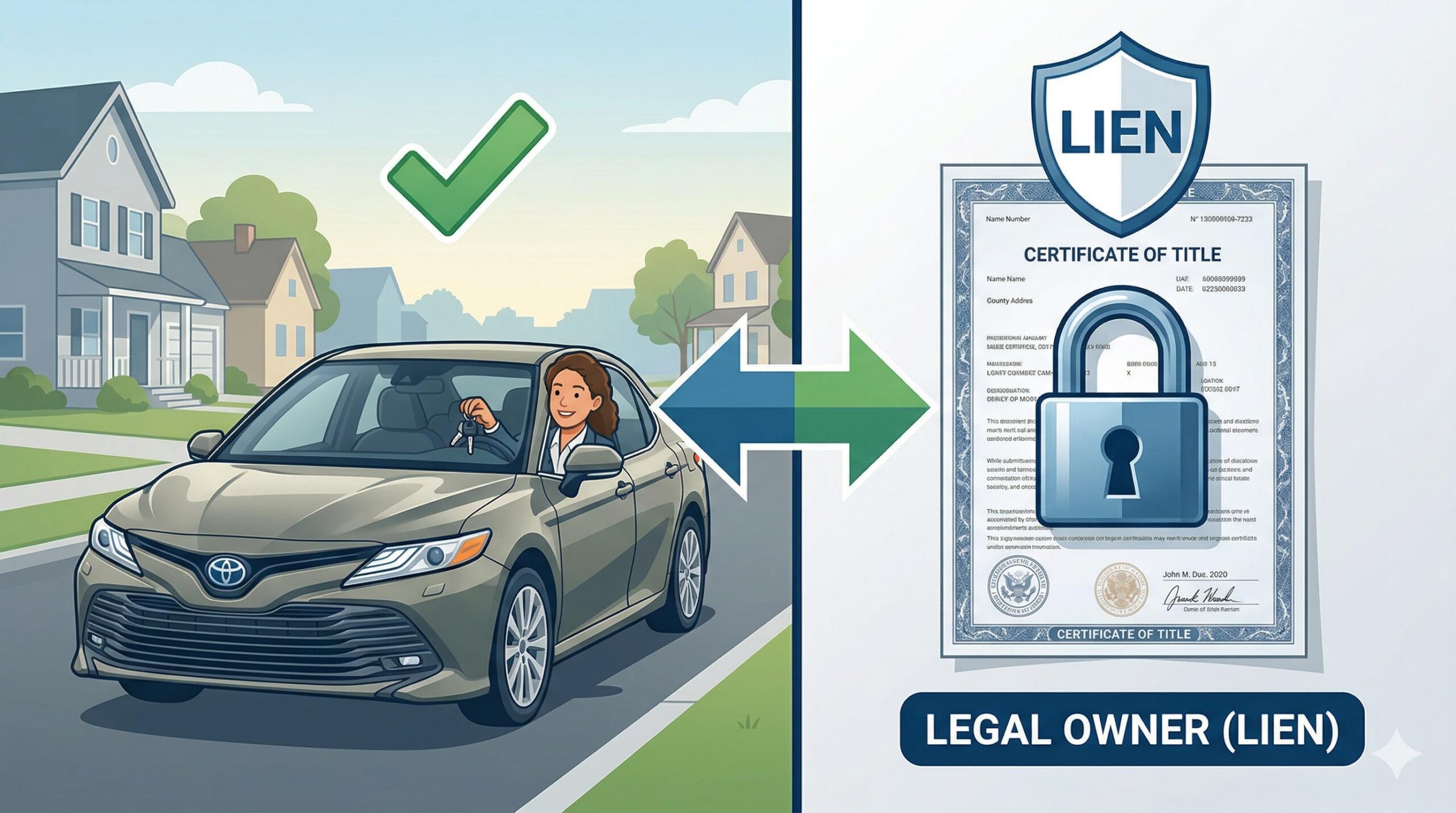
When you take out a title loan, you do not hand over your car to the lender. You continue to drive your vehicle as usual. Instead, you hand over the title (the legally binding document proving ownership). The lender will place a “lien” on your vehicle. A lien is a legal right to keep possession of property belonging to another person until a debt owed by that person is discharged. Once you pay off the loan in full, the lien is removed, and the clear title is returned to you.
The Appraisal Process
Because you are searching for local lenders, the process usually involves a physical appraisal. You will drive to the lender’s location, where an agent will inspect your vehicle’s make, model, year, mileage, and overall condition. They will compare this against standard industry pricing guides to determine its wholesale or auction value. Lenders typically only offer you a percentage of this value—usually between 25% and 50%—to protect their investment in case the car’s value drops or they have to pay fees to repossess and sell it.
2. Understanding Title Loan Interest Rates and APR
The most critical financial concept to understand about car title loans is how they are priced. Because these are short-term loans designed for high-risk borrowers, they come with significantly higher costs than traditional bank loans.
The Monthly Fee vs. The Annual Percentage Rate (APR)
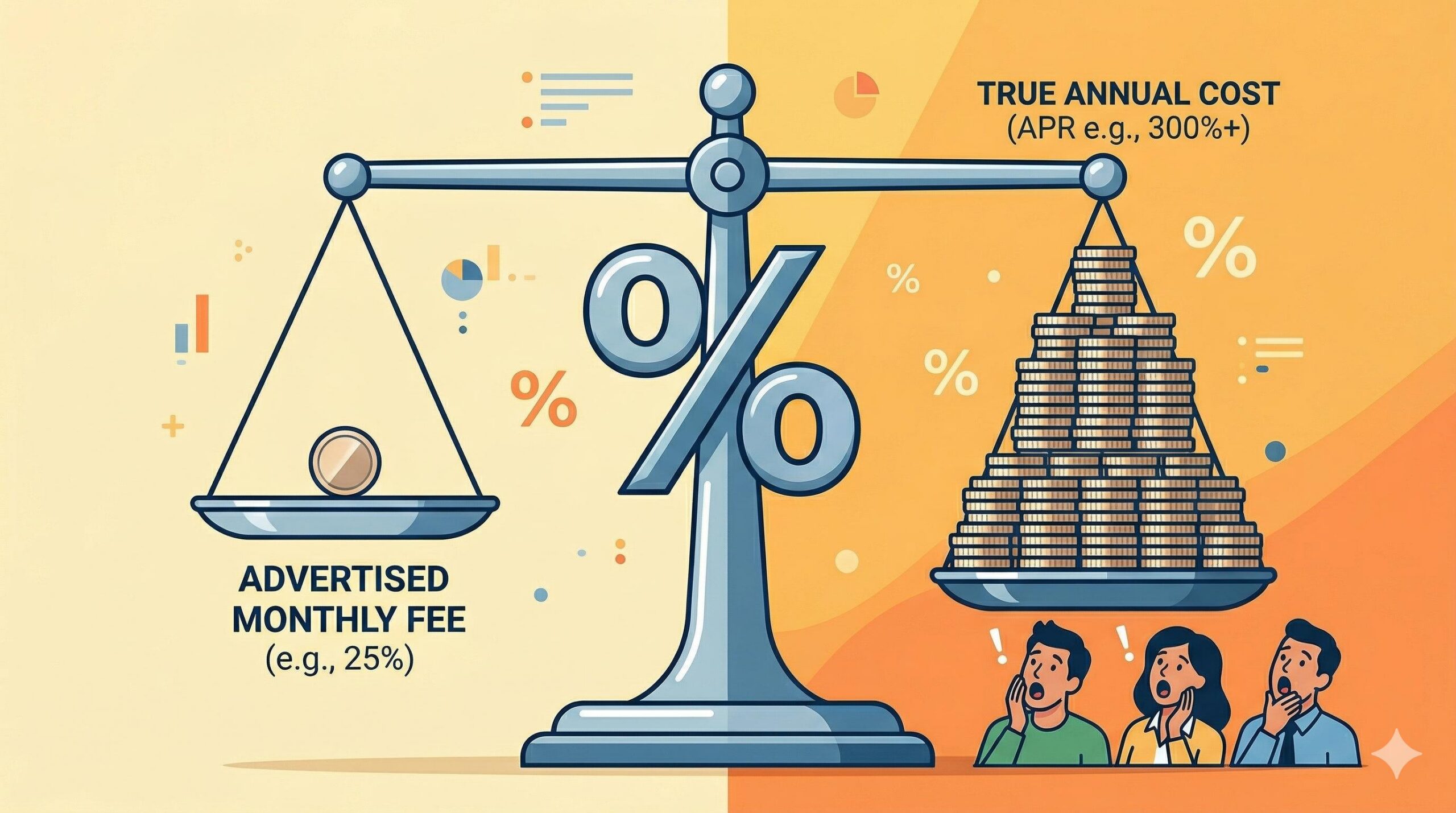
Local title lenders often advertise their costs as a monthly fee rather than a traditional annual interest rate. For example, a lender might charge a 25% monthly fee on the money you borrow.
If you borrow $1,000 with a 25% monthly fee, you will owe $250 in interest for a 30-day period. If you pay the loan back in exactly 30 days, your total repayment is $1,250.
However, to truly understand the cost, financial experts use the Annual Percentage Rate (APR), which calculates how much the loan would cost if it ran for a full year. A 25% monthly fee translates to a massive 300% APR (25% x 12 months). This is drastically higher than a standard credit card (which might have a 20% to 30% APR).
| Financial Product | Average APR Range | Collateral Required |
| Traditional Bank Loan | 6% – 36% | Usually No |
| Standard Credit Card | 15% – 30% | No |
| Car Title Loan | 100% – 300%+ | Yes (Vehicle Title) |
Risk Awareness: The danger of high APRs is the “debt cycle.” If you cannot pay back the full loan amount plus the high interest at the end of the 30-day term, the lender may offer to “roll over” the loan. This means you pay the $250 interest fee just to extend the loan for another month, but you still owe the original $1,000. Over several months, you could easily pay more in interest than the original loan amount.
3. Factors That Affect Your Loan Offer
When you visit a location offering car title loans near me, the representative will assess several factors to determine your rate and maximum borrowing limit.
Local Regulations and Usury Laws
Your geographical location is the biggest factor affecting your loan. Many countries and individual states/provinces have strict “usury laws” that cap the maximum interest rate a lender can charge. In some regions, car title loans are entirely banned. In others, they are heavily regulated, capping interest rates at 36% APR. The specific terms you are offered are entirely dependent on local legislation.
Vehicle Equity
You must have “clear equity” in the vehicle. This means you must either own the car outright (with no outstanding financing) or owe significantly less than what the car is worth. If you still owe $10,000 on a car worth $12,000, a title lender will not approve you, because the primary auto financier holds the primary rights to the vehicle.
4. Why Car Title Loan Applications Get Rejected
At loanrejectionhelp.com, we aim to educate borrowers on why financial institutions say no. Even though title loans are easier to get than bank loans, local lenders will still reject applications for the following reasons:
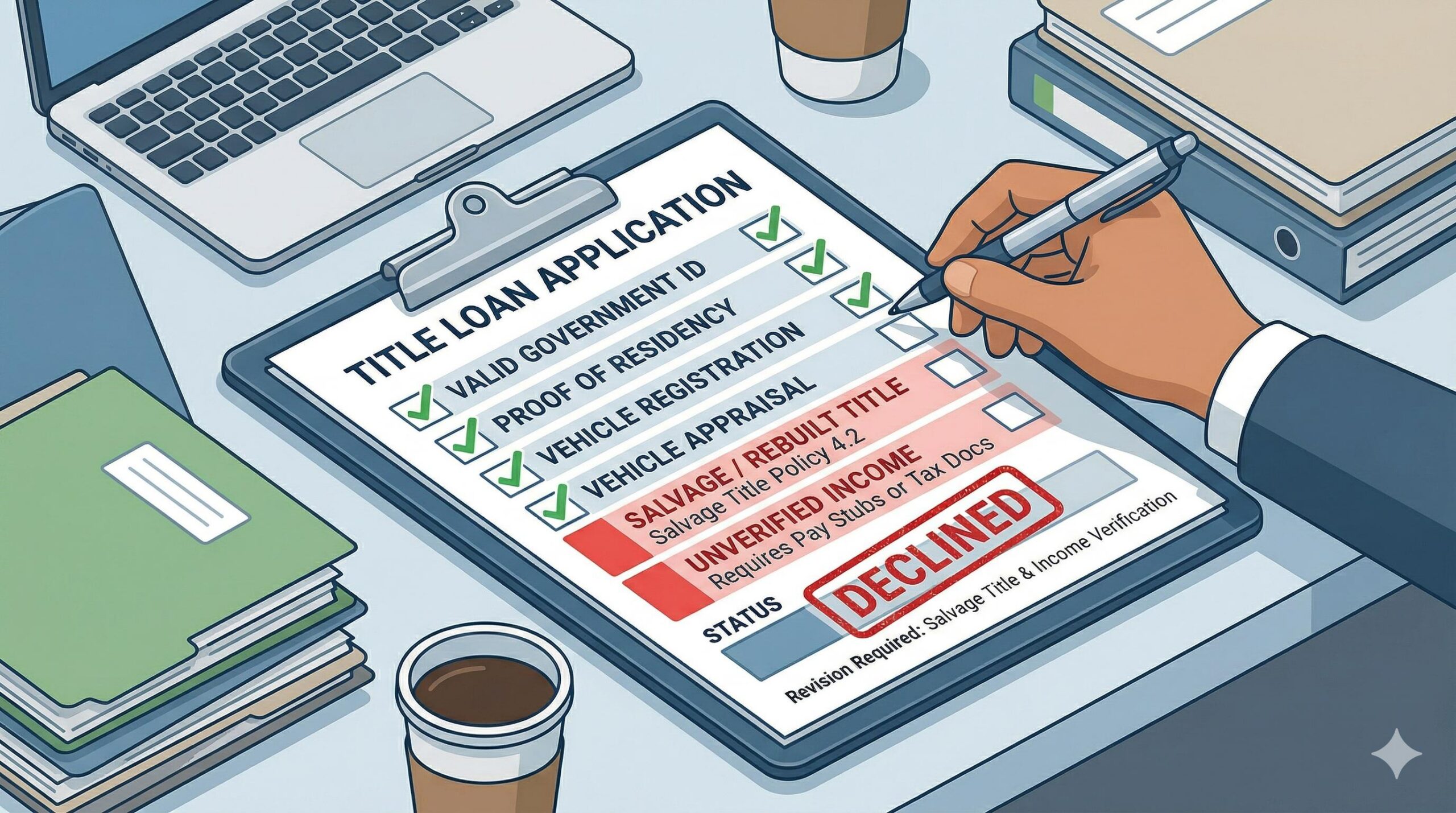
- Salvage or Rebuilt Titles: If your car has been previously written off by an insurance company and has a “salvage” title, its resale value is highly unpredictable. Most lenders will automatically reject collateral that does not have a “clean” title.
- Insufficient Income Verification: While credit scores are less important, lenders still need proof that you can repay the debt. If you are a self-employed professional with no bank statements or a salaried worker who cannot produce recent pay stubs, the lender will reject the application to avoid an immediate default.
- Co-Owner Disagreements: If the vehicle’s title has two names on it (e.g., you and your spouse), both parties usually need to be present and consent to the loan. If one party is missing, the application will be halted.
- Existing Liens: If you already have a title loan on the vehicle, or if a mechanic has placed a lien on it for unpaid repairs, another lender will not approve a second loan against the same asset.
5. Responsible Borrowing & Improving Your Approval Chances

If you are considering using your vehicle as collateral, it is vital to approach the situation with strong financial discipline.
Exhaust Safer Alternatives First
Before committing to a high-interest secured loan, explore other options. Can you negotiate a payment plan for the emergency bill you are facing? Do you qualify for a Payday Alternative Loan (PAL) from a local credit union, which offers heavily capped interest rates? Have you checked if a family member can co-sign a traditional personal loan for you?
How to Prepare if You Must Apply
If a title loan is your only remaining option, ensure your application is airtight:
- Bring the Correct Documentation: When visiting a local lender, bring your clear vehicle title, a valid government-issued ID, proof of local residency (like a utility bill), and proof of income (pay stubs or bank statements).
- Clean Your Vehicle: While the mechanical condition is paramount, presenting a clean, well-maintained vehicle can occasionally help the appraiser value the car closer to its maximum bracket.
- Borrow Only What You Need: Just because a lender offers you $5,000 against your car does not mean you should take it. If your emergency only requires $1,000, only borrow $1,000. This keeps your interest charges lower and makes it much easier to pay off the principal balance quickly.
A Complete Guide to Understanding BNZ Home Loan Rates & Approval Factors
Frequently Asked Questions (FAQs)
Q: Do I need good credit to get a car title loan?
A: No. Traditional credit scores are usually secondary in this process. Because the loan is secured by the physical value of your vehicle, lenders are more concerned with the car’s equity and your ability to prove a regular source of income to make the monthly payments.
Q: Can I keep driving my car during the loan period?
A: Yes. You hand over the legal title document to the lender, but you retain physical possession of the vehicle and can continue to drive it as long as you keep up with your agreed-upon loan repayments.
Q: What happens if I cannot pay the loan back on time?
A: If you default on the loan, the lender has the legal right to repossess your vehicle and sell it to recover their money. Alternatively, many lenders will offer to “roll over” the loan, which means you pay a large fee to extend the deadline, but this dramatically increases your total debt and traps you in a cycle of high interest.
Conclusion
Searching for car title loans near me is often the result of an urgent need for cash, but it requires a careful understanding of high-risk financial mechanics. These loans are strictly defined by leveraging your vehicle’s physical equity in exchange for short-term funding, usually at a very high Annual Percentage Rate (APR).
Your approval, the amount you can borrow, and the rates you are subjected to are dictated by local lending laws and the appraised wholesale value of your car. By understanding how liens work, the mathematical reality of monthly fees versus APR, and the strict criteria lenders use to reject applications (like salvage titles or lack of verifiable income), you can make a highly educated financial decision. Always prioritize responsible borrowing, have a strict repayment plan in place, and fully understand that defaulting on this type of loan will result in the repossession of your primary transportation.






2 thoughts on “A Complete Guide to Understanding Car Title Loans Near Me & Approval Factors”